


Monday was the big day. The day we’d been working toward for months had finally arrived: the day we’d hand over our policy paper. The policy paper is the final summary of all the work the Youth Council has done over the past few months—all the meetings with elected officials, all the discussions with experts, and all the debates we’ve had. Now it was time to present our thoughts, ideas, and concerns to policymakers, in the interest of better, sustainable, and future-proof food systems in Berlin.

The Weltacker Youth Council consists of dedicated young people from Berlin between the ages of 15 and 21. From September through December 2022, we engaged in an in-depth examination of Berlin’s food strategy and its challenges. Over the course of these four months, we held a total of eight full-day meetings, during which we explored Berlin’s food system and its issues, received thematic input on various subtopics related to (Berlin’s) food system from various experts, and visited the Spörgelhof, where we gained practical insight into agriculture. We also held a total of three discussions with representatives from Berlin’s SPD, Die Linke, FDP, and CDU.
The policy paper we drafted is the final product of all the input, meetings, and discussions. Here, we have summarized the most important points that, in our opinion, must be urgently implemented to make Berlin’s food system more sustainable and socially just.
The policy paper we drafted is the final product of all the input, meetings, and discussions. Here, we have summarized the most important points that, in our opinion, must be implemented urgently to make Berlin’s food system more sustainable and socially just.
The closing event and presentation of the policy paper took place on Monday, December 12, 2022, at the Gerhard Schlegel Sports School. In addition to about thirty interested attendees, Annette from the Food Policy Council, Alma from the Spörgelhof, two Berlin state legislators, and, of course, the entire Youth Council were present.
In addition to two speeches by Alma and Annette—who had already been actively supporting the Youth Council—the main highlight was, of course, the presentation of our policy paper. It was handed over to Ann-Christin Weber, representing the Berlin Senate Department for Urban Development, Housing, and Community Affairs (UMVK).

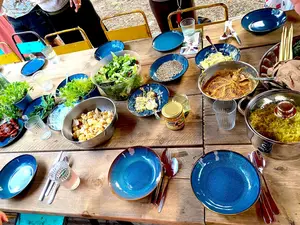
Afterward, everyone in attendance had the chance to look at the promotional posters Jamie had created himself, talk with the Youth Council members present about the policy paper, or simply enjoy the buffet.
Our demands focus on three main areas that we consider particularly important:
First and foremost is nutrition education. Nutrition plays little to no role in our schools, which leads to significant gaps in knowledge on the subject. How can people eat healthily and sustainably if they never learn how to do so?
Equally important to us is a socially just food system. Currently, sustainable eating is significantly more prevalent among privileged, highly educated, and affluent groups than in any other educational or socioeconomic groups. There are many reasons for this, not least the simply higher prices that are far too often charged for sustainable and healthy foods. A healthy diet must be equally accessible to everyone, regardless of their level of education, income, or background.
The third topic revolves around the Berlin-Brandenburg value chain—that is, the collaboration between Berlin and Brandenburg as an interconnected food system—and the question of how we intend to manage our resources in both states in the future.




Since 2022, the Weltacker Youth Council has been working with us—an exciting project that brings young people in Berlin together. They all share one goal: a voice in Berlin’s food policy!