


On April 26, the Youth Nutrition Council (JER) organized a cooking and discussion evening centered on the topic of the Planetary Health Diet (PHD). At the Baumhaus in Berlin’s Wedding district, participants exchanged ideas and discussed the PHD while also preparing and enjoying a delicious lentil soup. Among those in attendance were Jan Lehmann and Tamara Lüdke from the SPD, BVG cafeteria manager Harald Eck, and, of course, many interested people from Berlin.

At the beginning of the event, there was a brief presentation on the Planetary Health Diet (PHD), which also included a critical discussion. But what exactly is the PHD?
The Planetary Health Diet describes a diet that is both sustainable and healthy for the planet as well as for consumers. It was developed by the EAT-Lancet Commission, which consists of international scientists. The rationale behind the development of the PHD is that conventional agriculture accounts for an enormous proportion of global greenhouse gas emissions and thus contributes significantly to climate change and biodiversity loss. These emissions can be addressed by shifting agricultural production toward organic farming and by changing the dietary habits of many people.

The main components of this diet are plant-based foods such as fruits, vegetables, and legumes. Animal products such as meat, dairy, and eggs, on the other hand, make up only a small portion. Looking at global food consumption, the average person would need to eat about twice as much fruit, vegetables, nuts, and legumes, but also significantly less meat, fish, and dairy products.
Positive aspects and critical views of the PHD were discussed throughout the evening—both at small tables and in the larger group: The Planetary Health Diet offers an easily accessible approach to a healthy, sustainable, and scientifically sound diet. Points of criticism include, among other things, the fact that the PHD is not equally feasible everywhere in the world. It must be adapted to local climatic conditions from place to place. Furthermore, the graphic representation does not make it clear that a change in diet alone is not sufficient; production methods must also be altered.
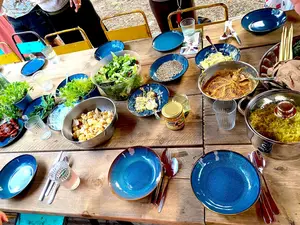
With so much discussion, you naturally get hungry. At the beginning, everyone chopped the vegetables for a lentil soup together so the stew could simmer in the background. By the way, you can find the recipe for the lentil soup on our Instagram channel! While we continued discussing things briefly over dinner, the conversation gradually shifted to more informal exchanges, and the event came to a lovely close.

All in all, we—the Youth Nutrition Council (JER)—had a wonderful event where many people were able to learn something new. There was a delicious soup, and there was plenty of networking—the JER was able to make new connections that will be very helpful in the future! And, of course, we can’t forget the beautiful venue, the Baumhaus Berlin.
By the way: We’re still open to new members—if you’d like to join us, send us an email.
The event was sponsored by the Senate Department for Justice and Consumer Protection




Since 2022, the Weltacker Youth Council has been working with us—an exciting project that brings young people in Berlin together. They all share one goal: a voice in Berlin’s food policy!