


Since September, the Weltacker Youth Council—made up of eleven dedicated young people—has been meeting, discussing, exchanging ideas, and taking action together.
We’ve already spent two weekends together. It’s a group of young people aged 16 to 21 who are advocating for a better food system in Berlin. After all, healthy food must be easily accessible to everyone! How can we feed Berlin regionally through Brandenburg in the future? What needs to happen to significantly reduce the proportion of imported goods and protect the environment? How can we create a fair, healthy, and environmentally friendly food system for the Berlin-Brandenburg metropolitan region?
We used our first meetings in September to come together and form the council. Bringing together the goals of each and every participant in the Youth Council quickly revealed to us the biggest problems with today’s food system. Initial objectives for the Youth Council meetings are taking shape. The first Youth Council weekend greatly strengthened us as a group and each and every participant. The commitment and collaboration create a very pleasant and hopeful atmosphere.

To explore this topic, we’ll take a look at the “Action Plan” from Berlin’s 2019 Nutrition Strategy. Goals for fair, regional, sustainable, and health-promoting nutrition have been developed across eight areas of action. These are approaches that we, as the Youth Council, fully support. However, it quickly becomes apparent that no concrete demands or goals have been formulated. Since 2019, the strategy has been guided by an action plan that contains neither strategic objectives nor a list of the resources available for the food transition. These are important frameworks with many gaps that the Weltacker Youth Council can build upon.

Some of the members of the Youth Council have already been exposed to issues such as agriculture, healthy eating, and dietary change through their personal circles. It is our goal to present as concrete a policy proposal as possible to policymakers in the winter of 2022. To achieve this, we would like to delve even deeper into the subject matter. How significant is the environmental impact of our current food supply? What current policy measures apply to the agricultural sector? Through a presentation by an education specialist from “Restlos Glücklich,” we learn a lot of new information on the topic of “Climate protection on our plates—and beyond.” We discover the significant impact our food system has on biodiversity and nutrient cycles, and we engage in discussion. Annette from the Berlin Food Policy Council explains what Transition Towns are and why children’s nutrition could be the key to a food system transformation. “The way we eat,” Annette points out, “is making us sick!” New knowledge requires a shift in thinking and collaborative efforts to devise solutions.

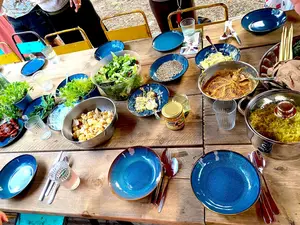
For lunch, we cook for ourselves—whether it’s vegetable soup with potatoes from the Berlin Weltacker or chili sin carne—and during our shared lunch break, we have lively discussions about what we’ve just learned. Our minds are buzzing, our hungry stomachs are full, and we’re off again.

High school students, college students, and participants in the FöJ program—we, the Youth Council. Our own experiences from our school days give us valuable insights into existing structures and methods for nutrition education. Young people must not have their futures cut short due to health problems resulting from poor nutrition! Is it possible to provide all children and young people with healthy, affordable, and sustainable meals in daycare centers and schools? After an introductory discussion on the topic of nutrition education, we’ll brainstorm and come up with some creative initial solutions. We ask ourselves: Why does nutrition still seem to be such an unimportant issue? We’d like to discuss this question and other points next week during our meeting with Dr. Turgut Altuǧ (Alliance 90/The Greens) and Ms. Ellen Haußdörfer (SPD). We hope for a constructive, open, and stimulating conversation.
We—the Youth Council—are looking forward to the upcoming discussions with elected officials, to future Youth Council meetings, and to continuing this inspiring journey together.
This project is funded by the Senate Department for the Environment, Mobility, Consumer Protection, and Climate Protection.




Since 2022, the Weltacker Youth Council has been working with us—an exciting project that brings young people in Berlin together. They all share one goal: a voice in Berlin’s food policy!