


"Nice vibe!!!"—that’s what a new volunteer from Peru said to me when I asked her how she was feeling that day. In the early afternoon, our season opener kicked off not only with a colorful program but also with a clear message: Global connections aren’t just something to be learned—they must be experienced.
Jana Siedenhans hosted the afternoon, guiding the program with a rare blend of energy, warmth, and heart. She immediately created an atmosphere where everyone felt welcome—whether old or young, new or longtime supporters of Weltacker.

After the program was presented, Member of the Bundestag Juliane Schneider (Greens) took the floor. Her opening remarks were moving: She drew a powerful connection between our small plot of land in Pankow and the global textile industry and the injustices prevalent there. Referring to her recent visit to Bangladesh, she made it clear: We know a lot in theory, but it is only seeing and experiencing things firsthand that drives us to act. The Weltacker is precisely this place of experience. The fact that she didn’t just speak her words but acted symbolically—by planting a berry bush, just like the other politicians that day—sent a powerful signal about our shared growth.

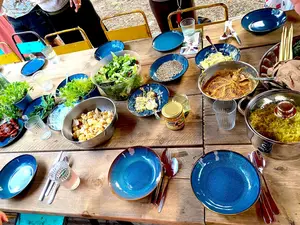
But then things really got going! The Pankow libraries brought laughter and wonder to the crowd with a children’s book reading. At Vincenzo’s booth at the Buchholz Community Center, young and old alike got to discover the art of painting plants. And anyone who was left wanting more found not only the best tacos at Tlayolan, our Mexican cultural initiative, but also the perfect workshop. The connection to the milpa on our farm became tangible here—a culinary journey right in the heart of Nordpankow.

As always, the “Worm Tent”—our soil research station and, currently, a recording studio for millipedes, mites, and springtails—was a big hit. For anyone who wanted to make their voice heard, the Weltacker Youth Council, with the support of artist Daniela Zambrano Almidón, offered the opportunity to design a protest banner. It was a moment of active engagement for our younger generation.

Those who wanted to explore the Weltacker in the traditional way, however, took part in the field tours—first in German, then in English. Led by Lea, the participants learned how the Weltacker got its name: It represents the amount of land that would be available to every person on Earth if we were to divide the world’s available farmland equally. The tour provided an overview of the distribution of crops on the field. Particularly engaging was the interactive “land buffet” game, which demonstrated how much space different foods require. A burger with a bun, tomato, onion, patty, chicken drumstick, cheese, and milk made it clear: Animal products require the most land—a central issue in global agriculture. In front of the cornfield, we learned that corn has been cultivated in a wide variety of colors for 8,000 years, but today yellow, genetically modified corn dominates supermarket shelves. Sixty percent is processed into animal feed, and 20 percent into biodiesel. The pig sculptures in the field illustrate that it takes exactly 2,000 m² to raise two pigs to slaughter weight—which doesn’t even cover the annual meat consumption of six people in Germany. A striking example of the land use associated with our diet. We then walked on to the vegetable fields, and Lea told us that lettuce, onions, zucchini, tomatoes, and cucumbers are often grown under plastic tunnels, and these cultivation areas are so large that in regions like Almería in Spain, they’re even visible on satellite images. The dance group “Dancers Without Borders” and our guests from Accra, Ghana, also joined the English-language tour and then prepared for their performance, “THE WATER BETWEEN US,” in an open rehearsal.

In between, City Councilwoman Manuela Anders-Granitzki and Lars Bocian (CDU) provided further important insights. They strongly emphasized how essential extracurricular activities and nutrition education are for our society. It’s impossible to imagine Nordpankow without the Weltacker. Their message was clear: To protect this place and our democratic values, it’s important to vote and not leave the district in the hands of radical forces. A call to responsibility that is rooted in the spirit of our garden. We’re also very excited to see the berry bushes grow; Mr. Lars Bocian told us about his green thumb and immediately rolled up his sleeves to get to work, just as Ms. Manuela Anders-Granitzki did.

The absolute emotional highlight of the day came with the presentation and performance of the dance theater project “THE WATER BETWEEN US” by Dancers Without Borders. The piece, which explores the connection between Accra & Ghana and Berlin & Germany through the themes of water and justice, deeply moved everyone in attendance. It was not merely a performance, but a shared reflection on what unites us and how we can face ecological challenges together.
A lighthearted, lively, and incredibly inspiring day came to an end. We thank everyone who came, participated, planted, danced, and discussed. Thanks to Jana, to all the politicians, to Tlayolan, Vincenzo, the libraries, and above all to the dancers of “Tänzer:innen ohne Grenzen.”
Let’s carry this “NICE VIBE” into the coming season!
Warm regards from Weltacker
Katharina




Since 2022, the Weltacker Youth Council has been working with us—an exciting project that brings young people in Berlin together. They all share one goal: a voice in Berlin’s food policy!