


Summer vacation in Berlin is slowly coming to an end, and unfortunately, our three-day vacation program is already over. So it’s high time for a quick look back:
Last week, from Tuesday through Thursday, the program at the Späth Nurseries featured acrobatics and soil science. The nine children, ages 6 to 11, who had signed up were treated to a varied program. Together with circus educator Charlotte Mehling (“Lotti”) and our education coordinator and soil expert Dr. Karin Pirhofer, we kicked off the first day with icebreaker games in the sun.
During this activity, we also became familiar with the first soil organisms: All the children and the educators had an animal pinned to their backs and then walked around in a circle. By asking each other questions, they had to figure out which soil organism they were representing.

After warming up with all the games, the acrobatics mats were brought out for the first time. Divided into pairs, the children performed their first simple exercises, including “soft spaghetti” and “hard spaghetti.” In “soft spaghetti,” one person lies on the mat while their partner tries to lift their arms and legs—which, however, remain completely loose and floppy. “Hard spaghetti,” on the other hand, involves lifting the person off the floor by their feet so that only their neck and the back of their head touch the floor.
We also learned about the “bench” position: A stable bench shouldn’t tip over easily, and the partner can try to lie down on it.


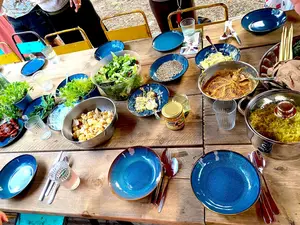
For lunch, we had waffles with applesauce. The only downside: Making good waffles in the outdoor kitchen turned out to be more of a hassle than we’d expected.

After lunch, the children continued with acrobatics. This time, Lotti had laid out mats in the back of the garden and placed cards depicting human statues on them. Some figures required two people, others three, and some even four. With great enthusiasm, the children kept rearranging themselves to recreate the various statues—such as a city gate. Of course, help was always on hand, and everyone was thrilled at how well they could recreate the figures together. As a result, they’d already put together their first sequence for the final performance.


Right at the very end, a few children who were up for it were lifted up by everyone else, all together, in the same position as the hard spaghetti!

The first day of the vacation program came to a close at the Weltacker. Clara, a volunteer doing her FÖJ, and Philipp, an intern, had organized a scavenger hunt. Working in teams of two, the children set off to find out, for example, what a milpa is or which plant is currently the largest in the field—and just then, the first parents arrived on the grounds to pick up their children.




Since 2022, the Weltacker Youth Council has been working with us—an exciting project that brings young people in Berlin together. They all share one goal: a voice in Berlin’s food policy!